The Misinformation Surrounding Indoor Air Disinfection and Ozone ~ Let’s Review the Scientific Literature
Ozone Indoors: A Hidden Health Hazard
Ozone is a regulated criteria pollutant, and most exposure to it happens indoors. Indoor concentrations tend to be lower than outdoors (smog), but people spend far more time inside. [1] The harm also goes beyond ozone itself: daily indoor intake of ozone oxidation products is estimated at one-third to twice the intake of ozone alone, and those products include formaldehyde, acrolein, hydroperoxides, and fine and ultrafine particles, all known or suspected health hazards. [1] The effect is measurable in mortality data. Differences in ozone-related mortality between U.S. cities appear to partly reflect how much outdoor ozone gets carried indoors. [2]
Bipolar Ionization
Consumer ionic purifiers have been measured producing ozone well above EPA, CARB, and OSHA safety levels. [3] A commercial in-duct needlepoint ionizer tested in an occupied office building reduced some hydrocarbons but increased others, most notably oxygenated VOCs such as acetone and ethanol, along with toluene. [4] Because air cleaners often run continuously and people spend most of their time indoors, exposure to both primary and secondary products may pose a significant risk. [5]
UV-C Light Bars
Germicidal 254 nm lamps can break down ozone into OH radicals, which oxidize indoor VOCs and form secondary organic aerosol. [12] Far-UVC at 222 nm, often marketed as safe for occupied rooms, has itself been identified as a source of ozone and secondary organic aerosol. [7] In real office tests, steady-state concentrations rose by 5–21 μg/m³, and how much depended heavily on how many people were in the room. [6]
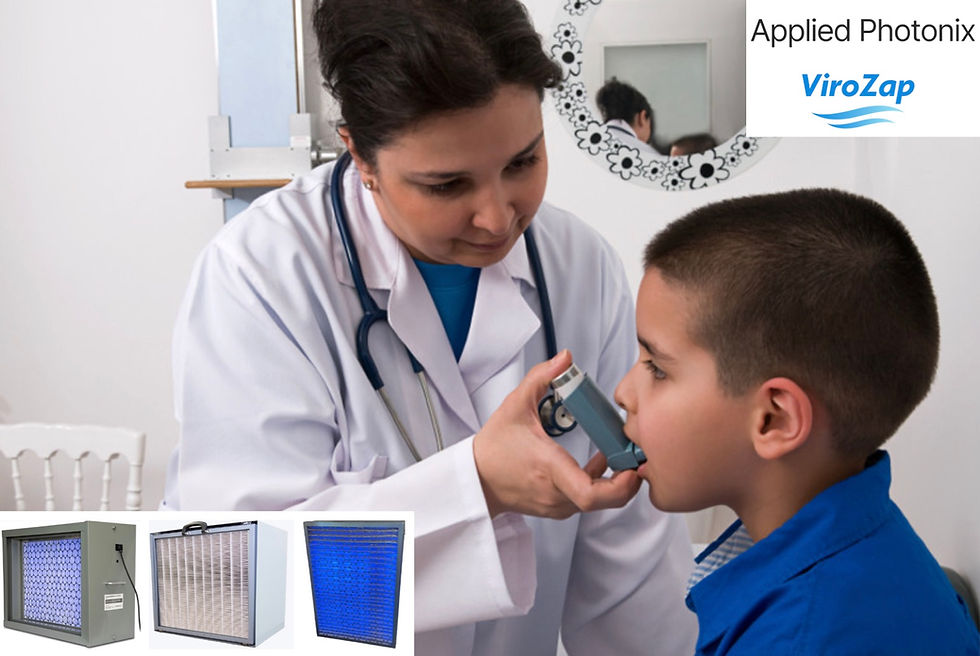
ViroZap®: A Different Approach

Applied Photonix's ViroZap (http://aphotonix.com) combines a pre-filter, a nanocoated filter, and UV-A LED lamps. [9] It does not use UV-C, which can damage the retina and burn skin, and the process does not produce ozone. [10] FDA granted ViroZap 510(k) clearance as a Class II medical device supported by testing at ARE Labs. [11] Because ViroZap operates inside the air handler or the duct work, it puts no ions and no germicidal light into occupied space, which removes the two main drivers of ozone-initiated chemistry in rooms.
Why Plasmonic Photonics Is Different
Conventional photocatalytic oxidation (PCO) has a documented weakness: incomplete oxidation can produce significant amounts of formaldehyde and acetaldehyde. [8] ViroZap's plasmonic photonic technology was engineered specifically to overcome this limitation. Applied Photonix uses a four-phase, patented destructive process. It captures and contains indoor pollutants, using low-power LED VU-A lights (safe-for-humans) to excite the catalyst on a nano-coated catalytic filter. The excited catalyst destroys all microbes and other organic molecules in the air passing through the filter.[11] The process results in:
99.9995% reduction of airborne RNA and DNA viruses
99.9997% reduction of airborne bacteria (both gram+ and gram-)
99.995% reduction of mold and fungal spores
Rapid Volatile Organic Compound (VOC) detoxification
No ozone or ozone byproducts, leaving only trace carbon dioxide and water vapor [13][14]
To learn more about Applied Photonix next generation technology, please contact us at tmurray@aphotonix.com.
References
Weschler, C.J. (2006). Ozone's impact on public health: Contributions from indoor exposures to ozone and products of ozone-initiated chemistry. Environmental Health Perspectives, 114(10), 1489–1496. doi:10.1289/ehp.9256
Chen, C., Zhao, B., & Weschler, C.J. (2012). Assessing the influence of indoor exposure to "outdoor ozone" on the relationship between ozone and short-term mortality in U.S. communities. Environmental Health Perspectives, 120(2), 235–240. doi:10.1289/ehp.1103970
Britigan, N., Alshawa, A., & Nizkorodov, S.A. (2006). Quantification of ozone levels in indoor environments generated by ionization and ozonolysis air purifiers. Journal of the Air & Waste Management Association, 56(5), 601–610. doi:10.1080/10473289.2006.10464467
Zeng, Y., et al. (2021). Evaluating a commercially available in-duct bipolar ionization device for pollutant removal and potential byproduct formation. Building and Environment, 195, 107750. Link
Collins, D.B., & Farmer, D.K. (2021). Unintended consequences of air cleaning chemistry. Environmental Science & Technology, 55(18), 12172–12179. doi:10.1021/acs.est.1c02582
Influence of germicidal UV (222 nm) lamps on ozone, ultrafine particles, and volatile organic compounds in indoor office spaces. Environmental Science & Technology (2024). doi:10.1021/acs.est.4c03903
Organic aerosol formation from 222 nm germicidal light: ozone-initiated vs. non-ozone pathways. Environmental Science: Processes & Impacts (2025). Link
Lawrence Berkeley National Laboratory. Evaluation of ultra-violet photocatalytic oxidation (UVPCO) for indoor air applications (LBNL-59631). Link
Applied Photonix. Applied Photonix device in contrast to ASHRAE Standard 241-2023. Link
Applied Photonix launches ViroZap, the first FDA-cleared medical device for in-duct air disinfection. PR Newswire. Link
Goswami, D.Y. Innovative new plasmonic photo-electrochemical technology for disinfection and purification of indoor air. ACHR News (2025). Link
Peng, Z., Miller, S.L., & Jimenez, J.L. (2023). Model evaluation of secondary chemistry due to disinfection of indoor air with germicidal ultraviolet lamps. Environmental Science & Technology Letters, 10, 6–13. doi:10.1021/acs.estlett.2c00599
Applied Photonix. ViroZap FAQs (four-phase process: capture and containment, photonic oxidation, plasmonic enhancement, clean output). Link
Applied Photonix. Plasmonic Photonic Air Purification Technology. Link


Comments